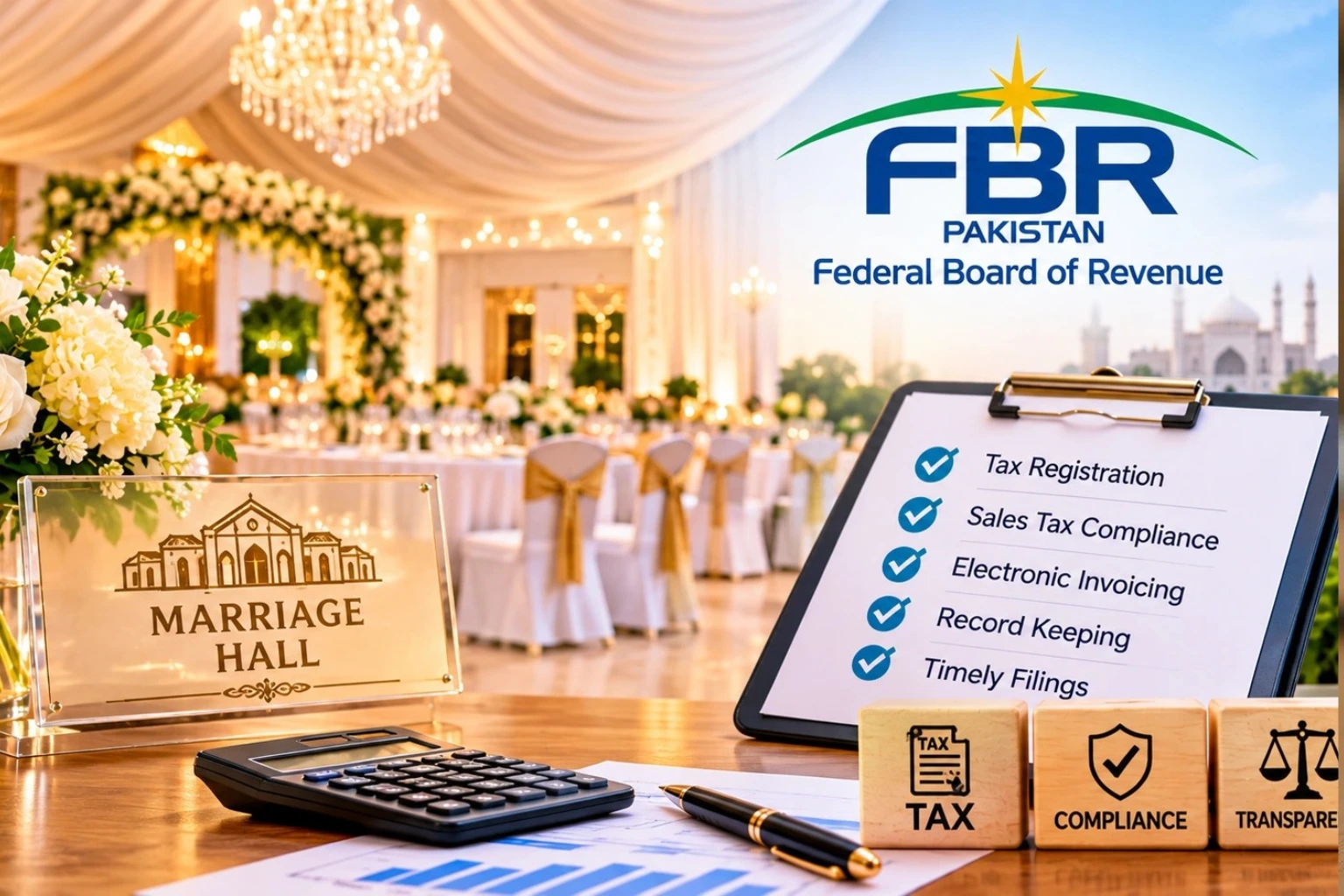
Marriage halls, wedding venues and marquee operators in Pakistan must manage several tax and documentation responsibilities. From income tax registration and provincial sales tax to electronic invoicing and financial recordkeeping, proper compliance helps businesses maintain transparent operations and avoid unnecessary tax complications. Understanding the FBR requirements for marriage halls has become particularly important as Pakistan continues to expand its digital tax documentation systems.
However, one important distinction is worth understanding: not every tax obligation of a marriage hall falls under the Federal Board of Revenue (FBR). Depending on the province, operators may also need to register with the relevant provincial revenue authority.
This guide explains the main tax responsibilities, invoicing requirements, recordkeeping practices and compliance considerations for marriage halls in Pakistan.
1. Understand Which Tax Authorities Apply to Marriage Halls
Before completing any registration, marriage hall owners should understand which tax authority regulates each part of their business.
Pakistan has a federal tax system and separate provincial sales tax authorities. The responsibility for collecting sales tax on services generally belongs to the relevant provincial authority.
| Province / Territory | Relevant tax authority |
|---|---|
| Sindh | Sindh Revenue Board (SRB) |
| Punjab | Punjab Revenue Authority (PRA) |
| Khyber Pakhtunkhwa | KP Revenue Authority (KPRA) |
| Balochistan | Balochistan Revenue Authority (BRA) |
| Islamabad Capital Territory | Federal Board of Revenue (FBR) |
For example, a marriage hall operating in Karachi generally needs to consider Sindh Revenue Board requirements for taxable services, alongside its federal income tax responsibilities.
Similarly, a venue operating in Lahore should examine the applicable Punjab Revenue Authority rules.
Important: Provincial sales tax registration does not automatically replace federal income tax registration or other applicable FBR obligations.
2. FBR Registration and Income Tax Responsibilities
Marriage hall operators earning business income must consider their income tax responsibilities under the Income Tax Ordinance, 2001.
The appropriate registration and filing requirements depend on the legal structure of the business.
For example, the operator may run the venue as:
- A sole proprietorship
- An association of persons (AOP)
- A partnership
- A private limited company
Depending on the business structure, the operator should complete the relevant FBR registration and obtain or use the applicable National Tax Number (NTN).
Key income tax responsibilities
Marriage hall owners should:
- Maintain an active and accurate tax registration.
- Declare business income in the applicable annual income tax return.
- Maintain records of revenue, operating expenses and business transactions.
- Report income according to the applicable tax rules.
- Meet withholding tax obligations where the business qualifies as a withholding agent.
- Keep supporting documents for business expenses and financial transactions.
For instance, payments to employees, contractors, suppliers and other service providers may involve withholding tax responsibilities, depending on the nature of the payment and applicable legal provisions.
Maintaining proper financial records makes it easier to prepare accurate tax returns and respond to any FBR inquiry.
3. Provincial Sales Tax Registration for Marriage Halls
Sales tax on marriage hall services is an important compliance area.
Marriage halls generally provide taxable services, and the applicable provincial revenue authority determines the registration, invoicing, tax collection and return-filing requirements.
Sindh: SRB requirements
In Sindh, marriage halls and lawns fall within the scope of taxable services under the Sindh Sales Tax on Services Act, 2011.
According to the Sindh Sales Tax on Services Rules, 2011, marriage hall operators must consider the following responsibilities:
- Register with the Sindh Revenue Board where registration is required.
- Charge applicable Sindh sales tax on taxable services.
- Issue serially numbered invoices or bills, or electronically generated invoices.
- Maintain records of taxable services and customer transactions.
- File sales tax returns and deposit tax within the prescribed deadlines.
An important point concerns the taxable value.
Under the relevant SRB rules, the gross amount charged for marriage hall services can include several components, such as:
- Venue rental and hall charges
- Catering services
- Pandal and shamiana arrangements
- Decoration and lighting
- Air-conditioning
- Event management
- Photography and videography
- Valet and security services
Therefore, operators should not automatically calculate their taxable amount using venue rental alone. They should examine the applicable rules and the actual services included in their event packages.
The SRB rules also provide a specific registration treatment for certain marriage halls operating within already registered hotels, restaurants, caterers or clubs, subject to the prescribed conditions.
Punjab: PRA requirements
In Punjab, marriage hall and lawn services fall under the Punjab Sales Tax on Services Act, 2012.
The PRA classifies these services under heading 9801.3000.
Marriage hall operators should check their registration obligations, applicable tax rate, invoicing requirements and return-filing schedule with the Punjab Revenue Authority.
The applicable rate and any available exemptions or concessions should always be verified against the latest provincial notifications.
Other provinces
Marriage hall owners in Khyber Pakhtunkhwa and Balochistan should also review the relevant KPRA and BRA legislation.
Tax rates, exemptions, registration procedures and filing requirements can differ between provinces.
For this reason, a marriage hall operating in multiple provinces should review its compliance separately for each location.
4. FBR POS Integration and Electronic Invoicing Requirements
Electronic invoicing is an important part of Pakistan’s tax documentation framework.
FBR has introduced online integration requirements under the Income Tax Rules, 2002, as well as separate electronic invoicing provisions for relevant sales tax registered persons.
Existing FBR integration requirements for marriage halls
Chapter VIIA of the Income Tax Rules, 2002 includes marriage halls and marquees in Schedule I.
The existing framework has specific geographical and business-category conditions:
- Companies are covered throughout Pakistan under the geographical provision in Rule 33A.
- Other taxpayers are covered in the specified districts listed in Schedule II.
- The existing Schedule I provides an exclusion where the covered area is less than 4,500 square feet and air-conditioning is not installed or available.
The two conditions in the existing exclusion must be considered together. A venue should not assume that it qualifies for exclusion simply because it has a smaller covered area or lacks air-conditioning.
The applicable requirements should be checked against the current rules and the operator’s actual business circumstances.
Important 2026 FBR development: S.R.O. 288(I)/2026
On 18 February 2026, FBR published S.R.O. 288(I)/2026 proposing amendments to Chapter VIIA of the Income Tax Rules, 2002.
The proposed schedule specifically included:
- Marriage halls
- Marquees
- Hostels
- Motels
- Guest houses
- Clubs, including race clubs
The draft proposed a different exclusion for premises where air-conditioning facilities are not installed.
It also outlined electronic invoicing and reporting requirements, including outlet registration, transaction reporting and digital invoice generation.
Legal distinction: S.R.O. 288(I)/2026 was published as a draft for public comments. Its proposed changes must not automatically be treated as the final applicable law. Marriage hall operators should check subsequent amendments, final notifications and applicable Income Tax General Orders before determining their exact obligations.
What does the proposed integration framework involve?
The February 2026 draft outlined several technical and operational requirements:
- Registration of business outlets and points of sale with FBR.
- Integration of electronic invoicing hardware and software.
- Generation of electronically verifiable invoices or bills.
- Transmission of invoice information to FBR’s computerized system.
- Generation of a unique FBR invoice number.
- QR code generation on customer invoices.
- Secure storage of invoice information.
- Recording adjustments, cancellations and modifications.
- Maintaining electronic transaction records for six years.
- Reporting system failures and operational disruptions within the prescribed period.
These provisions explain the direction of FBR’s proposed digital documentation framework. Their application must be determined according to the legislation and notifications currently in force.
5. What Information Should a Marriage Hall Invoice Contain?
Accurate invoicing is essential for financial transparency and tax documentation.
Every marriage hall should maintain a consistent billing process that records the services provided, amounts charged and applicable taxes.
A properly structured customer invoice should generally record:
- Business name and address
- Customer name and relevant details
- Invoice number
- Invoice date
- Event date
- Description of services
- Venue or hall charges
- Catering charges, where applicable
- Decoration and additional service charges
- Applicable sales tax rate
- Sales tax amount
- Discounts, if any
- Total payable amount
- Payment status
Where electronic invoicing rules apply, the business must also include the additional information required by the relevant authority and its prescribed invoice format.
Example of a marriage hall invoice
Consider a venue booking that includes hall rental, catering and decoration.
The invoice should separately identify the relevant charges so that the business can accurately calculate the applicable tax and reconcile the customer’s payment.
This approach also helps management understand which services generate the most revenue.
6. Maintain Proper Booking and Financial Records
Tax compliance is not limited to registration and invoice generation.
Marriage halls handle multiple events, advance payments, cancellations, vendor expenses and final settlements. Without an organized recordkeeping system, it becomes difficult to reconcile revenue and expenses.
Operators should maintain the following records:
Booking records
- Customer and event details
- Booking date and event date
- Hall or venue selection
- Agreed package and charges
- Advance payments
- Outstanding balances
Financial records
- Daily sales and receipts
- Bank transactions
- Cash payments
- Refunds and cancellations
- Discounts and adjustments
- Supplier and vendor payments
Tax records
- Sales tax invoices
- Tax collection details
- Filed tax returns
- Tax payment receipts
- Relevant withholding tax records
- Supporting financial documents
Maintaining these records helps the business prepare accurate financial statements and support its tax declarations.
It also reduces the risk of missing transactions or reporting inconsistent revenue figures.
7. Common Tax Compliance Mistakes Marriage Halls Should Avoid
Many compliance problems arise because businesses rely on manual records or do not review their tax responsibilities regularly.
Here are some common mistakes:
1. Ignoring provincial sales tax registration
Some operators focus only on FBR registration and overlook their provincial sales tax responsibilities.
Marriage hall services may fall under the relevant provincial sales tax legislation, so owners should verify their registration requirements.
2. Reporting incomplete event revenue
Recording only hall rental while overlooking other taxable charges can create inaccurate tax calculations.
Businesses should properly document catering, decoration and other services according to the applicable tax treatment.
3. Issuing incomplete invoices
Invoices without proper descriptions, dates, amounts or applicable tax details make financial reconciliation difficult.
4. Maintaining separate and inconsistent records
Using different registers, spreadsheets and accounting records without proper reconciliation can result in missing or duplicated transactions.
5. Ignoring electronic invoicing developments
Tax authorities continue to introduce digital reporting and documentation requirements.
Marriage hall operators should monitor relevant notifications instead of assuming that older billing procedures will always remain sufficient.
6. Missing tax return deadlines
Late filing or payment can result in applicable penalties and default surcharges.
A regular compliance calendar helps businesses avoid unnecessary delays.
8. How POS Software Helps Marriage Halls Manage Daily Operations
Managing a marriage hall involves more than issuing invoices.
A venue may handle multiple bookings, advance payments, event packages, catering charges, additional services and outstanding balances simultaneously.
A suitable Point of Sale (POS) and business management system can help organize these activities.
For example, a marriage hall management workflow can include:
- Customer booking and event management
- Advance payment tracking
- Final billing and payment settlement
- Service-wise revenue records
- Expense management
- Customer ledgers
- Daily and monthly sales reports
- Outstanding payment tracking
A computerized system also helps management retrieve transaction histories and reconcile financial records more efficiently.
However, choosing POS software does not automatically make a business tax-compliant. The software must meet the relevant authority’s technical and integration requirements wherever electronic invoicing or POS integration is mandatory.
Marriage hall operators should verify the software’s actual integration status before relying on it for regulatory compliance.
9. Marriage Hall Tax Compliance Checklist
Before finalizing their compliance process, owners and managers should review the following checklist:
- Identify the applicable federal and provincial tax authorities.
- Complete the relevant business and FBR registration.
- Obtain the applicable NTN.
- Check provincial sales tax registration requirements.
- Verify the current applicable sales tax rate.
- Issue properly numbered customer invoices.
- Maintain booking and payment records.
- Record event-related revenue and expenses.
- Review applicable withholding tax responsibilities.
- File tax returns and deposit applicable taxes on time.
- Monitor FBR electronic invoicing and integration notifications.
- Retain financial and tax documentation for the required period.
The checklist provides a practical starting point. The exact requirements depend on the business structure, province, registration status and applicable tax notifications.
Frequently Asked Questions
Do marriage halls need FBR registration in Pakistan?
Marriage hall operators earning taxable business income must consider their applicable income tax registration and filing responsibilities. The appropriate registration depends on the legal structure and circumstances of the business.
Is FBR POS integration mandatory for every marriage hall?
Not necessarily under identical conditions. Existing Chapter VIIA requirements cover specified marriage halls and marquees, subject to geographical and business-category conditions. The February 2026 S.R.O. 288(I)/2026 proposed changes to this framework. Operators should check the applicable rules and subsequent implementation notifications.
Can POS software help with marriage hall tax compliance?
Yes, suitable POS software can help organize bookings, billing, payments, expenses and transaction records. However, regulatory compliance depends on whether the software meets the specific electronic invoicing and integration requirements applicable to the business.
Conclusion
Understanding the FBR requirements for marriage halls is essential for venue owners who want to maintain transparent financial operations and meet their tax responsibilities.
From federal income tax registration to provincial sales tax, proper invoicing and electronic documentation, each area requires attention.
The most practical approach is to maintain accurate booking and financial records, issue properly documented invoices, file applicable tax returns on time and monitor changes in tax regulations.
A reliable computerized billing and business management system can also make everyday operations more organized while helping management maintain better control over revenue, payments and expenses.
Looking to improve your marriage hall’s billing and financial management? Explore how OneClick POS can help organize business transactions, payment records and reporting.